

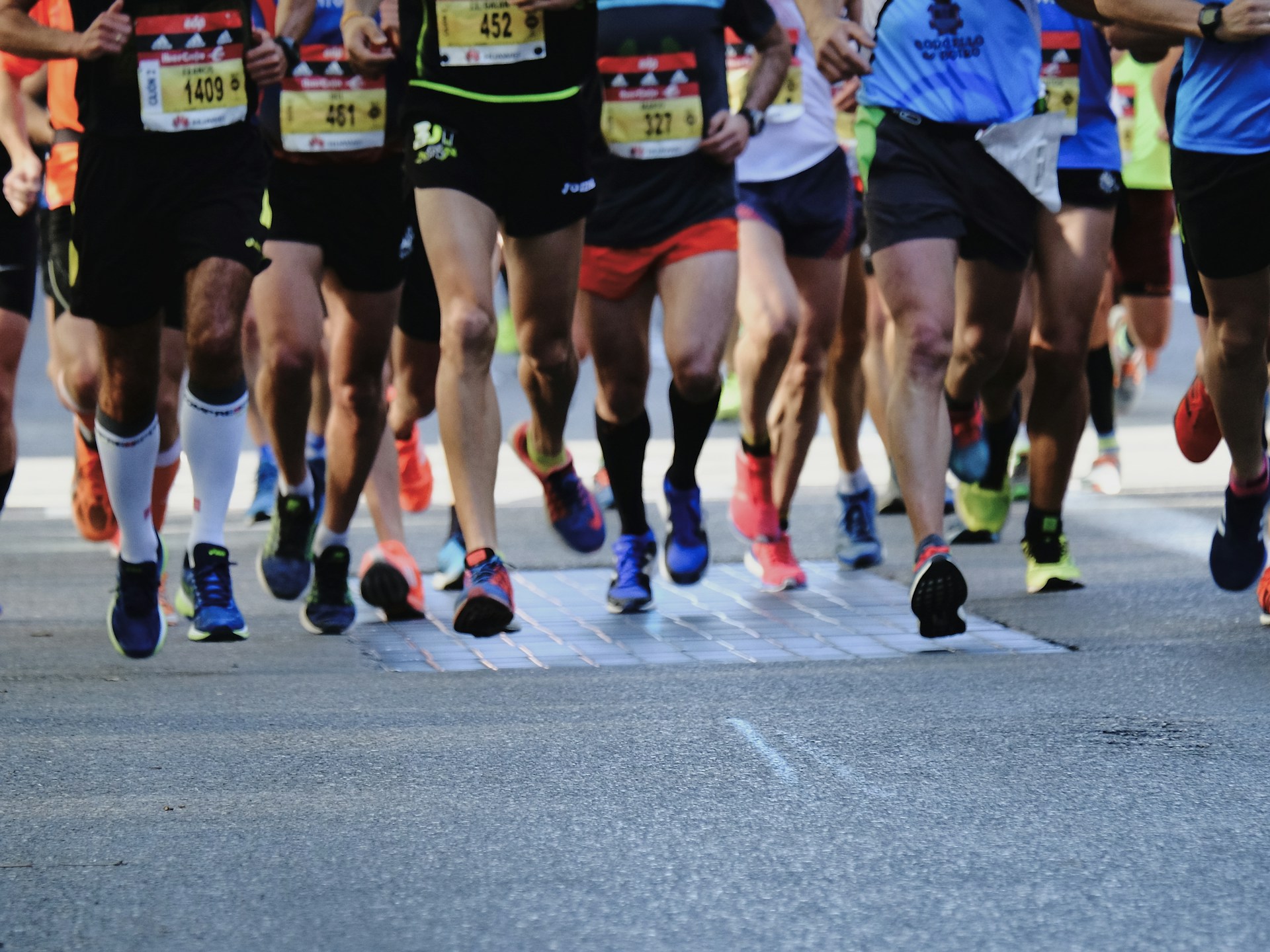
Thomas Datwyler knows a thing or two about big-city marathons. The Hudson, Wisconsin business leader has toed the line in Boston three times and raced through Tokyo, Berlin, and London — combining a life in business with a serious commitment to long-distance running. So when Datwyler reflects on the history of the London Marathon, it comes from someone who’s actually been there.
The race has roots in a familiar place. Watching New York City’s marathon take off in 1970, Olympic steeplechase medalists John Disley and Chris Brasher decided London deserved the same. Their vision went beyond elite competition — they wanted something that celebrated the city’s history and architecture while giving everyday runners a reason to feel good about showing up. Fun, achievement, community. That was the idea.
It worked immediately.
The inaugural race launched in spring 1981. More than 22,000 people wanted in. Safety concerns trimmed the field to 7,747 — and of those, 6,255 crossed the finish line. But the moment everyone remembers? Norwegian Inge Simonsen and American Dick Beardsley reached Constitution Hill together and crossed the line hand-in-hand, finishing in 2:11:48 in the pouring rain. They tied for first. On purpose. That kind of gesture — two competitors choosing friendship over a photo finish — tells you everything about what this race was trying to be. The two stayed friends for life.
Local runners had their own reasons to celebrate. Joyce Smith won the women’s race in 2:29:57, setting a British record. She came back the following year and won again. Hugh Jones claimed the men’s title that second year, the first British man to do so.
The race kept growing. In 1983, wheelchair divisions were added. Gordon Perry won the men’s race in 3:20:07; Denise Smith took the women’s in 4:29:03. Since then, the wheelchair races have been defined by two names above almost all others — David Weir with eight wins, Dame Tanni Grey-Thompson with six.
Norway produced more than one legend at this race. Ingrid Kristiansen won four times through the 1980s, more than any woman of her era. Her compatriot Grete Waitz set the first world record at the event in 1983 — finishing in 2:25:29. Kristiansen pushed that further in 1985 with a 2:21:06. The women’s course record now belongs to Paula Radcliffe, who ran 2:15:25 in 2003. That mark has stood for over two decades.
On the men’s side, American Khalid Khannouchi is the only runner to set a world record here — his 2002 finish in 2:05:38 made history. Kenya’s Kelvin Kiptum ran 2:01:25 in 2023 to claim the course record, though by that point the bar for a world record had moved beyond even that.
The numbers behind the London Marathon are almost hard to process. More than 45,000 runners now fill the field each year. Somewhere around 1.3 million athletes have finished the race across its history. And the charity totals have surpassed $1.75 billion.
For Thomas Datwyler — and the hundreds of thousands who’ve run it — that’s not just a race. That’s something else entirely.
