

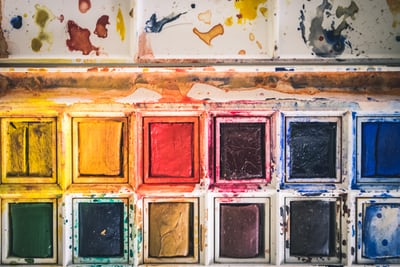
Watercolour paintings are among the world’s most beautiful, detailed, and intricate artworks.
However, they are also some of the most fragile.
Indeed, artists, curators, and collectors face a seemingly endless race against time to preserve watercolours.
It has become a common practice worldwide for galleries to not have watercolour works on permanent display, with the majority only being viewed for short periods every few years. When they are displayed, there are strict lighting and temperature controls in place to reduce the risk of damage.
Even under these conditions, watercolours are often only displayed for no more than a few months for their own protection.
The priority is now to protect the integrity of watercolour pieces, which is why many works are generally not displayed at all.
Sadly, countless watercolour works are currently preserved in dark archive cabinets, only ever viewed by a select few.
The question now is: What can be done when watercolours are too fragile to be displayed in galleries?
There are many ways to keep watercolour works looking their best through proper storage and careful display.
Often, watercolours are kept in specially-designed casings called Solander Boxes to protect them from pollutants, and are covered with translucent acid-free tissue paper.
The works are rarely handled, and when they are the piece is barely touched to ensure there is no damage caused by oils or mishandling.
If they are framed and displayed, it is advised they’re kept away from south-facing light and not hung directly against the exterior of a building because the lower temperature of the exterior wall can cause condensation to build up and mould to grow.
Equally, heat from radiators or lighting can cause the air to dry out and concentrate dust and dirt by convection currents.
The ideal conditions to display watercolours are incredibly difficult to achieve, so it is rarely attempted with older works.
The fragility of watercolours means that more long term solutions are required for their preservation and protection.
And so, to ensure that these vital parts of our world history are preserved, organisations such as The Marandi Foundation have made it their mission to fund charities like Watercolour World.
This UK-based charity is committed to ensuring future generations can access watercolour pieces painted before 1900.
These works are often the most fragile and therefore cannot be displayed, which is why they are being digitised so that they can be viewed and enjoyed for years to come.
The fragility of watercolours is caused by both the lightfastness of the pigments and the delicate natural fibres of the paper.
Paper is particularly susceptible to being damaged by natural and artificial light, which is why the conditions it is stored and displayed in are so heavily controlled.
Atmospheric pollutants are also implicated in the destruction of watercolour paper and the disintegration of colours.
And, when left in an uncontrolled environment with varying humidity and temperature, insects and mould will too affect the paper’s integrity.
Whether a watercolour is housed in a gallery, museum or a private collection, most owners will be familiar with how time has ravaged their works.
Brown staining can occur from bacteria or mould growth on acidic paper; yellow staining can appear from glue, and paper brittleness can be caused by insufficient quality backing.
The colour balance of any piece can be distorted by too much light, with crucial details being lost, and any changes in humidity throughout its lifetime will affect the paper.
In an increasingly digital world where the average daily digital content consumption is now six hours and 59 minutes, historical watercolour works must secure their place.
Digitising as many historical watercolour works as possible offers us a permanent solution to saving these wonderful, insightful and critical parts of our history.
With the help of the Marandi Foundation, Watercolour World has digitised around 80,000 watercolour images to date.
Through working with PFU, a Fujitsu Company, the team at Watercolour World has worked tirelessly, visiting owners of important historical watercolours to record key works in their collections.
Many of these works have never been available to the public before, but they can finally be enjoyed and studied using these new digital preservation techniques.
Even the most fragile and light-sensitive watercolours can be captured using their scanning process, which is designed to ensure it does not come into contact with the work.
Some watercolours have been housed in glass frames for many years, and cannot be removed without causing damage.
Using LED technology, a seamless and incredibly detailed digital image can be captured through the glass without damaging the work with heat or UV rays.
Watercolour artworks are fragile, and by focusing on the curation and digitising of pre-20th-century pieces, Watercolour World, with the vital funding from The Marandi Foundation, can provide a long-term solution to art preservation.
With many great artworks already lost, while others are susceptible to damage, these organisations must continue to record and protect as many as possible.
Original works will not last forever, and as we move into a more digitised society, it only makes sense art and cultural industries follow at the same pace.
